

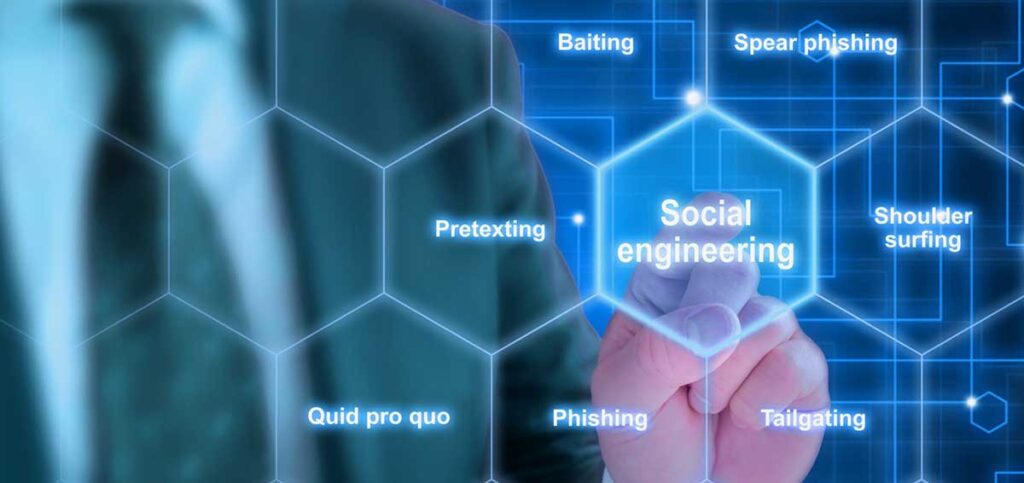
Social engineering is on the rise and technology is no longer a back-office function; it’s the backbone of every small and medium-sized enterprise (SME) in the UK. From finance to HR, marketing to operations, every department relies on digital systems to drive performance, deliver customer value, and maintain competitiveness.
Yet, while firewalls, antivirus software, and cloud backups have become standard, the most dangerous cybersecurity threat facing UK SMEs isn’t technical at all, it’s human.
Welcome to the world of social engineering: the silent, sophisticated art of manipulating people to bypass security controls and gain access to systems, data, or money.
🎭 What Is Social Engineering?
Social engineering is a form of cyber-attack that uses psychological manipulation rather than hacking tools. Attackers deceive employees into giving up sensitive information, granting access to systems, or performing actions that compromise security, often without the victim realising anything went wrong.
Unlike traditional malware or ransomware attacks, social engineering exploits human behaviour, not software vulnerabilities. And it was social engineering that caused most of the devastating cyber-attacks carried out on high-profile UK retailers this year.
📌 Why SMEs Are Prime Targets
UK SMEs are especially vulnerable to social engineering for a number of reasons:
- Limited in-house cyber expertise: Many SMEs do not invest in fully comprehensive IT Support, leaving gaps in awareness and response times.
- Smaller budgets: Fewer resources mean limited investment in employee training, advanced detection tools, or security monitoring.
- Agile (but risky) workflows: Flexible processes are efficient but may skip key verification steps.
- High impact: A single attack can cause disproportionate financial and reputational damage.
According to UK Government figures (2025), 85% of UK businesses experience phishing attempts each year. Worse still, stolen credentials are involved in over a quarter of successful breaches (IBM, 2024).
🔍 Common Social Engineering Tactics
Attackers use a variety of methods to exploit trust and trick people into making costly mistakes:
- Phishing: Mass emails disguised as legitimate communications that lure users into clicking malicious links or attachments.
- Spear phishing: Targeted emails crafted using personal or company-specific information to make them more convincing.
- Business Email Compromise (BEC): Posing as executives, partners, or suppliers to trick staff into transferring money or sensitive data.
- Pretexting: Creating a fake identity (e.g., pretending to be IT support or a government official) to extract confidential information.
- Vishing and Smishing: Voice calls or text messages used to impersonate trusted entities and pressure victims into fast decisions.
⚠️ Real-World Examples UK SMEs Face
- Fake supplier invoice: A finance team member receives an email from a familiar supplier asking to update bank details. Funds are transferred, straight to the attacker.
- CEO impersonation: An urgent email from a “Managing Director” instructs an employee to share payroll data. The domain is slightly altered, but the damage is done.
- Credential theft: An employee reuses a password leaked in another breach. Attackers gain direct access to internal systems.
- Phone scam posing as IT: A caller claims to be from your MSP, urging the user to install a “security update,” which is actually malware.
Even ONE successful incident can disrupt operations, damage client trust, and result in regulatory penalties under UK data laws.
🛡️ How to Defend Against Social Engineering
Protecting against social engineering requires a holistic approach; not just technology, but also people and processes.
- Educate and Train Employees
Awareness is your first line of defence. Train staff to:
- Identify phishing and suspicious emails; simulated phishing tests can help with this
- Question unexpected financial requests
- Report strange messages or calls
- Establish Strong Verification Processes
Implement simple but effective policies:
- Always verify bank detail changes with a phone call to a known contact
- Use secondary verification for sensitive requests
- Enforce Multi-Factor Authentication (MFA) across systems
- Deploy the Right Technology
Technology can help catch what humans miss:
- Use advanced email filters (e.g. Microsoft Defender)
- Protect devices with Endpoint Detection such as Sophos or Microsoft Defender, and /or MDR
- Monitor unusual activity with a SOC (Security Operations Centre) which is provided by Sophos MDR
- Prepare for Incidents
Have a tested incident response plan:
- Know who to contact
- Outline containment steps
- Define communication protocols
Run mock drills so your team knows how to act quickly and confidently.
🔮 The Evolving Threat Landscape
Social engineering is evolving and getting smarter:
- AI-powered attacks: Deepfakes, voice clones, and hyper-targeted phishing campaigns are on the rise.
- Credential abuse: Reused passwords and weak credentials remain a major vulnerability.
- Remote work risks: With hybrid setups, attackers have more entry points, from personal devices to unsecured networks.
This makes proactive investment in security and training non-negotiable.
✅ What SMEs Can Do Today
Even small actions can make a big impact:
- Run a phishing simulation to test staff readiness
- Enable MFA on all business-critical apps
- Review how you verify financial and data-related requests
- Update your incident response plan
- Audit your vendors and cloud services for hidden risks
🔐 Turn Vulnerability into Resilience
Social engineering may be the most widespread and effective cyber threat facing UK SMEs but it doesn’t have to be your weakness.
With the right mix of awareness, culture, processes, and technology, SMEs can turn this risk into a competitive advantage. A security-conscious organisation not only protects its data and finances, it earns the trust of customers, partners, and investors.
Need help building your SME’s cyber resilience?
As a people-focused MSP, Minerva IT Support helps businesses design and implement smart, secure IT strategies that scale with their growth, without breaking the budget. We can advise and help you with any of the issues raised in this blog.
Let’s turn your team into your strongest security asset and help you protect your business from the threat of social engineering.
Call us now on 01707 607100 or book a friendly chat in with us via Calendly